Your cart is empty
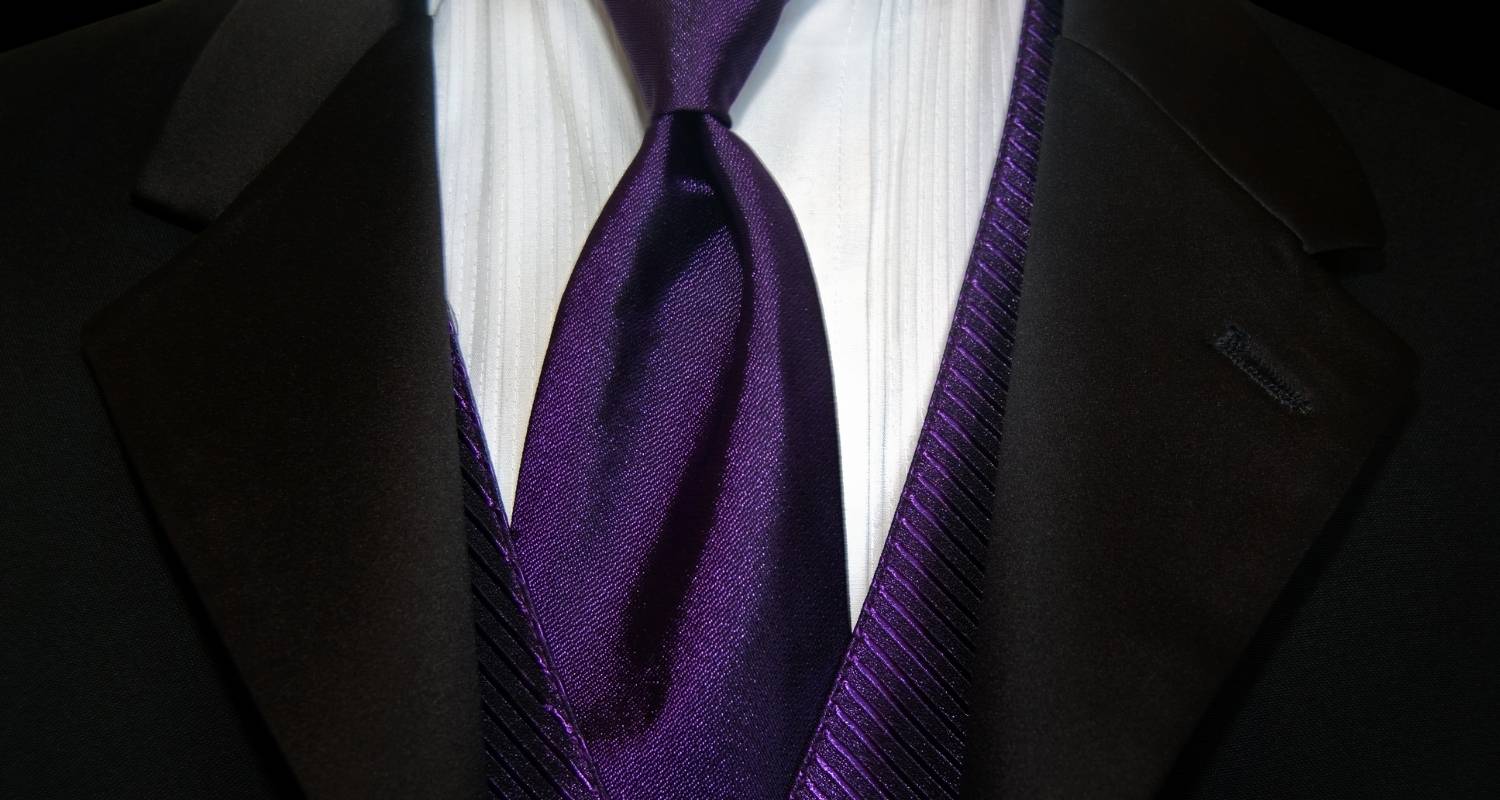

Purple is the color of power!
We're saying it: Purple is often overlooked in men's fashion. Many men consider it too feminine and don't wear it. But gentlemen, you're wrong. Purple is powerful, especially in men's clothing.
Let's take a closer look at the color mauve and how to wear this tie.

The color purple shows people that you are confident . People who see purple associate it with royalty and wealth, creating a lasting impression that will help you build professional relationships with others .
Purple also shows that you are modern and open-minded.

Think of the color purple . Does royalty come to mind? Throughout history, the color purple has often been worn by members of the royal family.
And only by royalty. When purple dye was first created (a gruesome process using a species of sea snail), it was very expensive.
It was so expensive that the only people who could afford to buy this dye were members of the royal family.
During the Elizabethan era, Queen Elizabeth I maintained this exclusivity of purple and forbade anyone outside the royal family from wearing this color.
Eventually, more affordable synthetic purple dyes were created and the rest of us, the common people, began to wear purple.

Purple is a combination of red and blue and comes in many shades. Some are light, some are dark, and some are more pink, more red, more blue, or even more brown. The most common shades of purple are standard purple and dark purple.
We often see these colors used in sports team colors, school colors, and company logos. Certain shades of purple are more popular in certain seasons.
Lavender, a light pastel purple, is a staple of spring and Easter. Aubergine purple, a deep purple with red undertones, is more popular in autumn and winter. We also see many shades of purple in food. Think of berries.
Despite the word "black" in "blackberry," this berry is actually a deep purple. Raspberries are a reddish shade of purple, as are blackberries. Shades of purple are also found in many red wines. Merlot, Cabernet Sauvignon, Pinot Noir—these are all reddish-purple wines.
Purple comes in many shades. Some are light, others are dark, some are more red, more blue, and even more brown.

Now let's talk about wearing purple ties . If you're not used to wearing purple, don't worry, we'll make it easy for you. Wearing a purple tie is done in 4 steps.

First, find a shade of purple you like. As we mentioned earlier, there are many shades of purple. You might not like them all, and that's perfectly fine. There are enough shades of purple that you're sure to find one or two you like. So find that shade and keep it in mind.
Now that you know which shade(s) of purple you like, find one or two ties in that color. Go to our collection of purple ties and look for ties in those shades.
It could be a plain mauve tie or a mauve patterned tie . As for the style, choose what suits you best. If you like self-tie bow ties, look for a purple self-tie bow tie.
Do you like traditional ties? Check out the standard ties. Prefer a more modern tie? Narrow, thin, or slim ties are probably your thing.

Okay, now it's time to wear that purple tie. To get used to wearing purple, keep the rest of your outfit neutral.
Choose a plain white shirt. If you wear purple to the office or in a more casual setting, opt for navy, grey, or brown trousers, a suit, or a sports jacket.
Purple and black can be worn together, but it's generally a more formal look. If you wear a pocket square with one of these colors, it should match the tie or be plain white.

After regularly wearing purple with these neutral colors and getting the hang of it, you can start adding small touches of other colors to your look.
However, you should be careful. While purple can be worn with other colors, too much of it can make you look like a clown. So, to begin with, stick to wearing suits, sports jackets, and/or trousers in these neutral colors.
As for your shirt, a subtle checkered or striped pattern with pops of color can look great with a purple tie. Look for a shirt whose colors complement your purple tie. Perhaps a similar shade of purple (lighter or darker) or a blue.
Other colors can be carefully added to your accessories as well. (A pocket square, a lapel pin, a tie clip, socks, etc.) For small items like these, we like to look at the color wheel for inspiration.
The least extreme colors to add are those next to violet on the color wheel, which is called an analogous color scheme. These are red and blue.
Reds and blues go well with purple, and a white pocket square with a red tip or a blue tie bar can really add some dimension to a look.

Just remember to find accessories in the same tone as your purple tie. (Darker purples will go better with darker blues and reds, etc.)
If you want something a little bolder, turn to complementary colors on the color wheel. For purple, these are yellow, orange, and green.
Again, be careful when adding these colors to your purple tie, but they can have a very sharp effect when used correctly.
So, first of all, choose one accessory to wear in these colors, and only one. (A yellow pocket square, a green tie bar AND orange socks is too much. Choose one).
Next, find an accessory in the same shade as your tie. Are you wearing an aubergine purple tie ?
Burnt orange complements this deep purple. A lavender tie? Opt for pale yellow accessories.
If you've made it this far, you're now a purple pro. Go find yourself a purple tie and start wearing it. It won't be long before someone compliments your new look.
Comments are approved before publication.