Your cart is empty
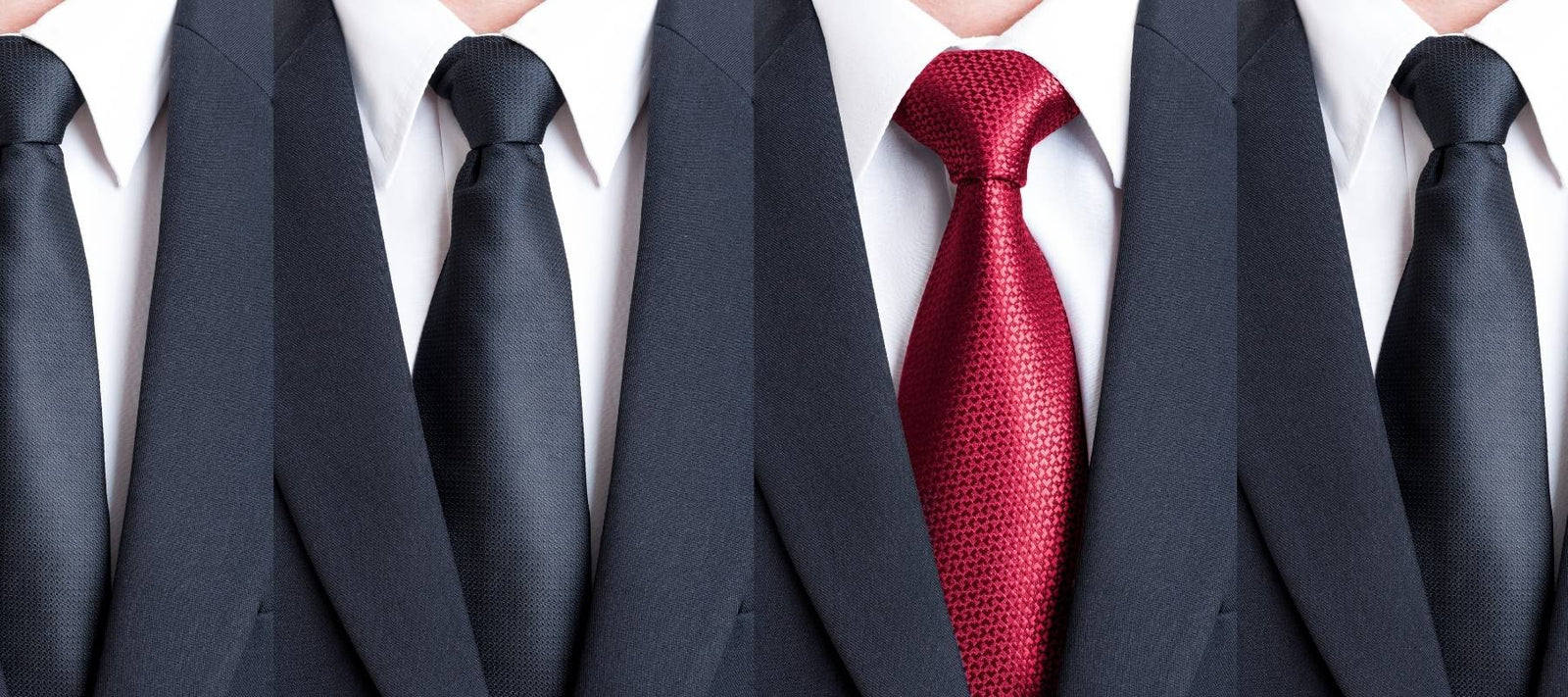

From ancient China to Wall Street, the red tie has always symbolized aggression.
It's not called the tie of power for nothing: by wearing a red tie, you show that you are serious.
It symbolizes wealth, strength, authority, domination, and passion. In many cultures, it also symbolizes luck.
For the ultimate power effect, opt for a bright red tie, such as a solid red or ruby red silk tie. For a less aggressive approach, replace your bright red with a softer shade of burgundy.
When you look at Donald Trump, he usually tries to emphasize something red, thick, and hanging below the belt. I'm talking about his tie—his power tie, to be precise—the one he wore at his inauguration, which has become a staple of Trump caricatures.

Power ties, like the one worn by former businessman Trump, became famous in New York in the 1980s and, like Trump's business card, have historical and scientific significance beyond their phallic appearance.
From the French aristocracy to the presidency, the history of the tie of power could just as easily be the history of power itself. It can also be linked to the decline of American "greatness.".

Let's start with China, in 210 BC.
Believe it or not, the earliest examples of red power ties are not only linked to manic leaders, but also to walls.
During the first dynasty of imperial China, Emperor Qin Shi Huang commissioned many projects of absurd scale, including an early version of the Great Wall of China and a large terracotta army comprising some 6,000 terracotta soldiers.
These soldiers, assembled to guard his body in the afterlife, were painted with red ties resembling bandanas . If the emperor did not wear them himself, the luxurious dyed clothing on his warriors reflexively indicated his own extravagance.
The painting of ties has since disappeared, unlike the aesthetic of megalomania that was associated with them.

The following example is over 300 years old: Trajan's Column , a victory monument to the Roman emperor Trajan. It would be an exaggeration to call Trajan's necktie a necktie—it's more of a cape—but his soldiers wear something resembling a scarf around their necks.
Whether they wore it for utilitarian or other reasons, these soldiers belonged to Rome's largest army and enabled Rome to reach its greatest size.
Since the military color of Rome is red, we can assume that the scarves of this column, once painted, were also red . I would classify this scarf in the category of "red ties," you see what I mean?

It's no coincidence that these ancient Roman and Chinese soldiers chose red. It's science. Before continuing the story, it's worth noting the numerous studies on the link between red and competitive behavior.
According to research compiled by Psychology Today, wearing red provides a competitive advantage. It makes you feel more dominant, and to your opponent, it makes you appear more dominant and threatening .
Red has also been associated with higher testosterone levels . So, if you're someone who can't stand having red in their face (maybe you have orange in your face), wearing red can signal your capacity for aggression.
A red power tie is worn by someone who is drawing attention to their power, much like a frigate trying to assert itself.

These soldiers wore pieces of red cloth tied around their necks, and they had to be quite aggressive to gain an audience: After meeting them, King Louis XIV adopted their headgear.
It became known as the tie: a mispronunciation of the French word for Croatia. While Croatia is very proud of this heritage (in 2003, they tied a gigantic red tie around the Roman amphitheater - you have to see it to believe it), it was King Louis XIV himself, with all the power of a 17th-century French king, who made this style a coup.
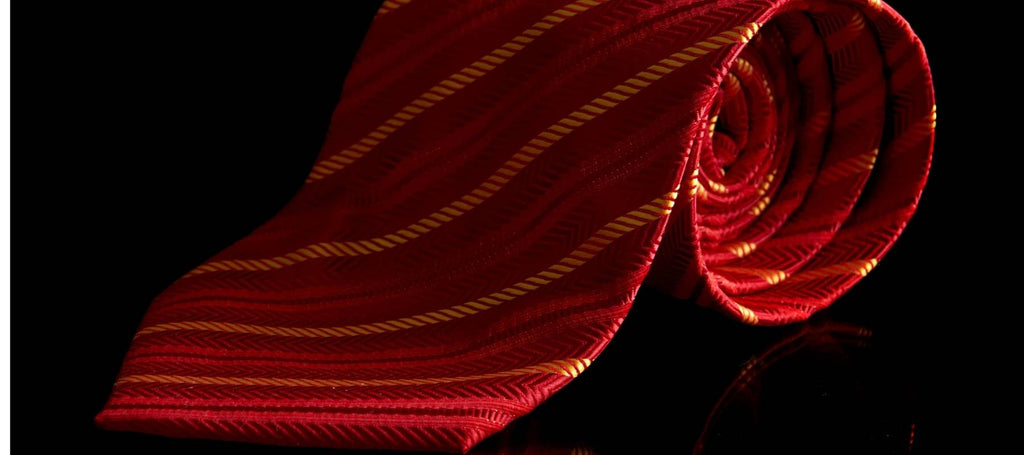
The necktie spread like wildfire and became a staple of the upper class, according to the classic principle "Monkey see, monkey do".
H. Le Blanc 's seminal work , L'art de nouer la cravate (The Art of Tying a Tie), published in 1829, describes ties as a "letter of introduction".
According to Le Blanc, each nation had its own style. The American tie " has the appearance of a column, intended to support a Corinthian capital ."
So you can attribute any column-shaped tie to the American style - and I think most business ties fall into that category.
In the 1920s, America established itself as a major player in the history of the tie thanks to New Yorker Jesse Langsdorf , a tie maker (it was once a trade) who used 45-degree angles and a three-part construction to create the tie we've all poured mustard on.
And it really was all of us. The tie became a staple of almost every man's everyday wardrobe. Arguably, that was when America was the last "great" nation. Okay, let me explain.
The manufacturing industry represented a large part of a company's revenue, which was good because it meant more jobs for unskilled workers.
The prosperity of uneducated white men flourished, because there was no need to go to school - it was enough to start working.
In the background of all this, men wore hats and ties for everything, so the president didn't dress very differently from ordinary people. This probably lent a certain power to wearing a tie.
Every tie was a power tie (though, remember, reds are always more powerful). America experienced a period of reasonable economic prosperity (if you were white) and "greatness" (if you were white).
Then the sources of power began to change. The American manufacturing industry reached its peak in the 1970s and subsequently began to decline.
Corporate revenues shifted from manufacturing to stock trading, and power, like the power of the French king, returned. It had a new home: Wall Street.

With this new power came the latest form of power fashion and its inevitable Hollywood icon: Gordon Gekko .
Gordon Gekko is the fictional tycoon at the center of Oliver Stone's film Wall Street. Originally conceived as a tragic figure, Gekko has become a popular hero to aspiring rich people, and his fashion is a central element of his appeal.
Wall Street has proven that it's possible to sharpen the ego with bright colors, shiny accessories, and high contrast. Gekko is the brainchild of menswear writer Alan Flusser, who described Gekko's look as "fuck you clothes." Fuck you, I make money. Fuck you, I have power. Fuck you, I'll fuck you.

And that brings us to Trump , himself a product of 1980s American business style, with power ties similar to Gekko's. Thick. Seemingly expensive. Worn too low. Red.
Most often, his ties are the same royal red as his " Make America Great Again " caps. He commands attention. Aggressive. Again, I'm talking about his ties.
While one might think that red simply aligns him with his Republican cohort, the idea of the red state/blue state is actually only as old as Bush versus Gore, and Trump's love for red-tie power games is much older than that.
For example, his board game uses the same image of Donald in a red tie for the box cover, the rulebook, and even his fake Trump bucks - the smallest denomination of which is $10 million.
Obviously, all of this serves to give Donald a powerful image. There's even something admirable about the fact that he wears his own brand (even if it's a bit like wearing his own band's T-shirt).
As president, Donald Trump will receive several presidential portraits; you can bet that in most of them, he will be painted wearing a white shirt, a blue suit, and his signature plain red tie.
Comments are approved before publication.